Veterans Day 2015 – Thank you for your sacrifice.
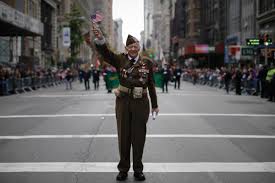
My mother joined the Navy when I was 8 years old and after my parents divorced, and she served in the Navy for 16 years. I was reared by my father, and I had little contact with my mom as I grew precisely because she was off serving in foreign countries – even at the South Pole. And I was proud! I have always spoken with pride about my mother as a sailor and veteran, and in doing so, I have always used the language of service to refer to what she was doing – for what all armed forces men and women do. But lately I’ve started to rethink that language.
It probably began when a next-door neighbor recounted that her six-year-old son loved to run up to people in military uniform, salute them proudly and say, “Thank you for your service.” This young man’s mom had noticed that it often made the recipient uncomfortable – particularly younger vets – and she found that a curious response. More pieces fell into place when I spent an entire day in a workshop with Dr. Rita Brock of Brite Divinity School. Her presentation on PTSD and moral injury in veterans returning from conflicts over the past twelve years was stunning – gut-wrenching even. Some of the most profound moments in the presentation were those devoted to images of how PTSD literally changes the way the brain functions. But conversations with students in the college English classes I teach brought it home. When I listen to these young men and women discuss their time in Afghanistan or Iraq, when I watch their faces drain of color every time an unexpected fire alarm goes off on campus, I realize I find it impossible to think of the vets as “having served.” Instead, I see instead sacrifice.
When an individual joins the military in the United States, the first thing s/he sacrifices is youth, and in a culture obsessed with youth, that means a great deal. While many of the recruit’s peers are headed off to college, the recruit is in boot camp being broken down as an individual so that s/he can function effectively as a soldier in a unit. The years served are a sacrifice of life and energies but also of opportunities. Vets who leave the military after just four years of service are now four years behind their age group in education and work experience. Yes, they have just as valid knowledge and experience from their time in the military, but in today’s job market, the privilege is on the side of formal education and time spent working your way up from the lowest of the jobs in a given field. This gap in time and education will stay with the vet for years – the sacrifice is not of four years – but of many – even if they begin school as soon as they arrive home. The average vet sacrifices his or her educational and employment aspirations to serve our country.
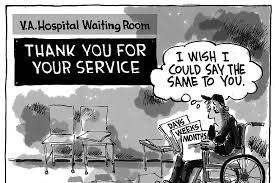 At the same time, vets sacrifice their long-term well-being. After their time in the military, vets are put into a health care system that is overloaded and underfunded. Regardless of media reports to the contrary, the VA is not a pariah – not a monolithic entity out to harm vets. The VA is, however, incapable of attending to the needs of all the vets we have in this country – some 21.8 million. I ask you to consider how you might fare – how you might feel – if you were competing for effective and compassionate medical care with 21.8 million other people at only 150 hospitals and 820 clinics. If you don’t live within 40 miles (as the crow flies) from a clinic or hospital, you can receive permission to see a more local facility or doctor – and the paperwork will keep you busy for a few weeks each time. Helping my mother attend to her medical needs for the last fifteen years has left me screaming at doctors and weeping in frustration, but it isn’t my sacrifice – it is hers. She will live with a sub-par medical system and miles of red tape as she ages. I am just a family member who gets to watch her struggle, but then that too is a form of sacrifice.
The families of vets in this country sacrifice also – willing to do what it takes to protect their loved ones and their families. Imagine the sacrifice involved not just in living without your spouse for a period of months or years as you continue keeping food on the table… the bills paid… the children taxied as part of regular life, but also in allowing your loved one to be changed, perhaps even harmed, in ways you cannot understand or heal. The soldier who leaves on deployment, whether to a war zone or not, is not the same husband or wife – not the same parent or child – who returns. The sacrifices made by military families are, in essence, the signing up for marital strife, for family stress, for single-parenting and all its attending social and economic strains. The families of our vets sacrifice as well, and it is often an invisible sacrifice. In fact, most of the sacrifices I’ve been discussing are invisible. And that is not an accident.
A couple of things are going on when we talk about vets and statistics that make the sacrifices invisible. To begin with, vets are increasingly women and people of color – groups we find it easy to ignore even when they aren’t military personnel.
- Female vets are about 10% of the vet population right now, and in the next thirty years, that number will be 17% – nearly one fifth of our veteran population.
- People of color make up 20% of our vet population today, and in thirty years will be more than 30% – one-third of the vet population.
- Currently, only 26% of vets over age 25 have a college degree, a number made more profound by the fact that vets are able to receive a college education for free. But free tuition isn’t an education. A college education requires the social resources to study and the cognitive resources to study – both of which are eroded by the post traumatic stress disorder and moral injury vets often return from deployment managing. Again, Dr. Brock’s work at Brite Divinity School is eye-opening; I can’t encourage you enough to seek it out in person or online.
So the invisibility of vets is not simple; it is an invisibility complicated by issues of socioeconomics, race, education level and sex to start. And these issues are further complicated by emotional and psychological needs we barely understand as a culture.
The current stereotypes surrounding vets returning from the last two decades of conflicts in the Middle East most often involve the idea that these folks are unstable. This is heartbreaking, but it is true. While increasing attention to PTSD and moral injury is excellent news for vets who suffer, in our sound-byte/ PowerPoint culture that asks few questions, the attention feeds a stereotype that vets are not safe to have around. Too often the result is employers who are loath to hire folks they see as loose canons and educators being warned to watch for signs that vets are about to blow. My own vet mother, a loving soul and an advocate for veterans at every turn, is not immune. When I recently mentioned that I have several vets in my classes this semester, she abruptly switched from her discussion of how vets are not given equal opportunities to a word of warning: “Don’t give those students any “F”s!” She’s partly joking; this is her sense of humor. But she’s also my mama; she wants me safe. She is a vet, but she is also media savvy and has heard enough coverage on vets to be afraid – even of those she knows intimately to be good and deserving people. Vets sacrifice. They sacrifice even their identities as individuals – becoming invisible or a stereotype and sometimes even to themselves. And all of these sacrifices are simply not covered by using language that says they “served.”
 I am a word girl. I can’t help it. So as I struggled with my discomfort with the language of “Thank you for your service” I see everywhere, I turned to one of the texts I consider close to sacred – the Oxford English Dictionary. The verb “sacrifice” in the Oxford English Dictionary is defined in numerous ways; the definitions I am most struck by are:
“To surrender or give up something for the attainment of some higher advantage or dearer object” and “to permit injury or ruin to the interests of a person for the sake of some desired object.” The dearer object, the desired object, for a soldier is protection of country, home and freedom. I don’t have to agree with my government’s policies or decisions to send soldiers oversees to fight to acknowledge that veterans have surrendered their well-being – permitted injury or ruin to their own interests – for the sake of protecting my country, my home and my freedom. I can vehemently pray for peace and still know I am called to serve those who sacrifice.
See, the definition of the verb “serve” in the OED includes all the language you would expect to be associated with clergy – not soldiers. “To perform the duties, to render service, to perform for a term of service under a master,” all of which fall short of the sacrifices made by men in women in our armed services. Their terms are never over; what they give up is not simply the performance of duties. Part way through the list of definitions, the verb “serve” takes on a more specific character – starting with the definition of serve as “to minister to the comfort of...” What follows are numerous entries regarding the work of priests and ministers – those serving God – those serving the Eucharist. I would suggest to you that it is we who are to serve, and that one way to serve God is to serve those who sacrifice. This Veteran’s Day, when those in government jobs are off work, when students in public schools have no classes, and when so many Americans are at the mall shopping the Veteran’s Day sales, I ask you who are called – lay and ordained – to serve those who have sacrificed. I ask you to serve by seeing the sacrifice made by men and women during their time in the armed forces and far, far beyond. I ask you to serve by seeing the sacrifices others do not see or at least find difficult to understand. And I ask you to serve by “ministering to the comfort of” those who sacrifice – whether in rendering material aid, providing pastoral care or simply giving voice to the sacrifices these brothers and sisters – these children of God – have made.
I am so proud of you and your words! Thank you for a beautiful essay! (mama)